











Prompt Detail
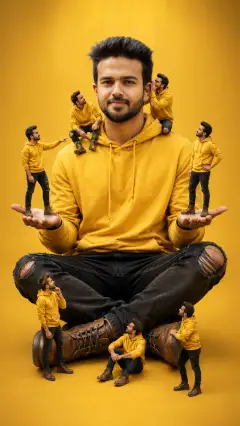
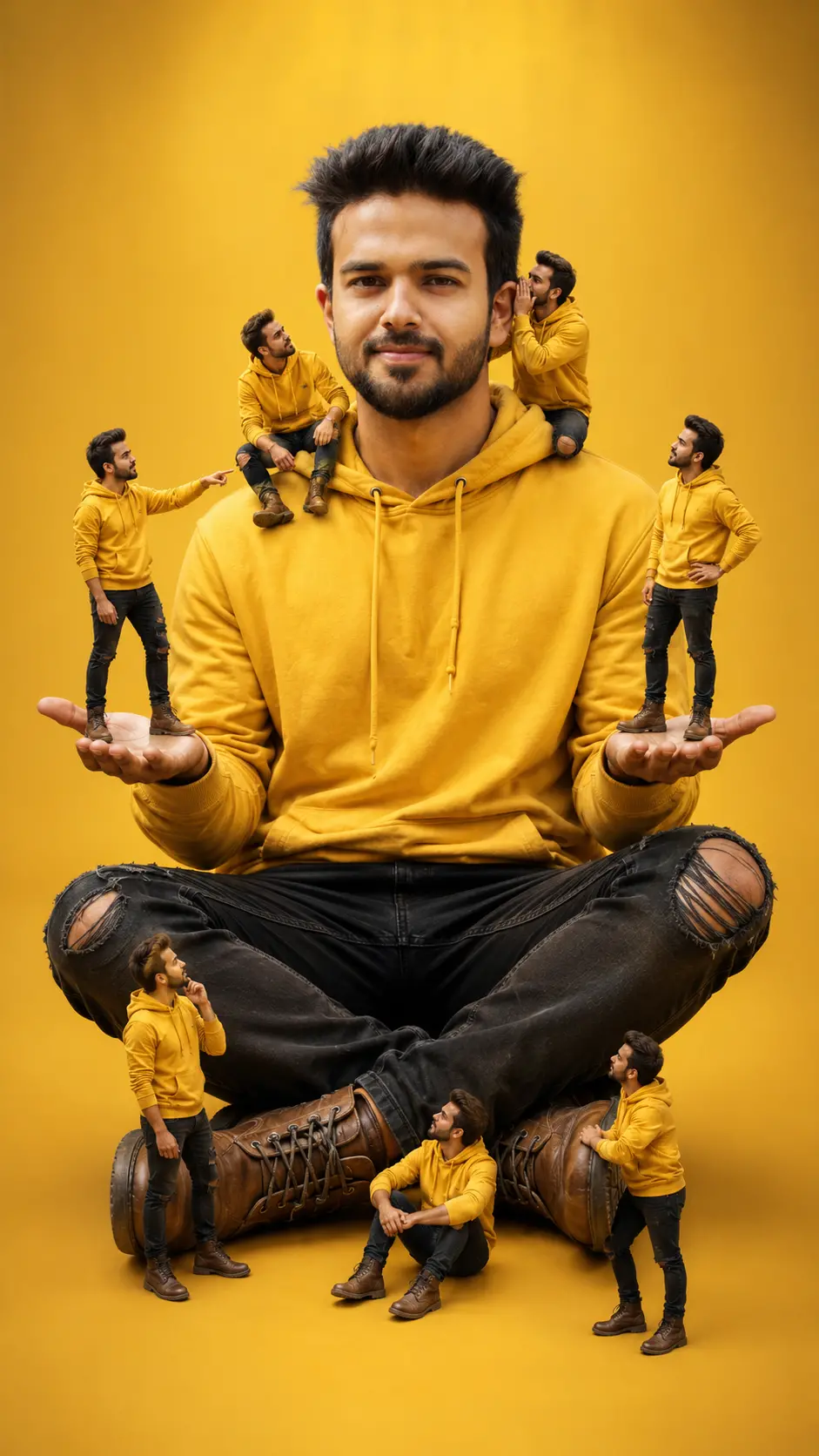
Creative Portrait with Multiple Miniature Clones in Yellow Hoodie on Vibrant Background
Copy Prompt
Copy the full prompt text to use it anywhere you like.
Copy was blocked by your browser. Select the prompt text below and copy it manually.
Choose image aspect ratio
Selected:Original keeps the saved wording. Choosing a ratio edits the copied text; also set the output size in your image tool.
Copy was blocked by your browser. Select the prompt text below and copy it manually.
Prompt guide
How to use this AI image prompt
Overview
This creative portrait prompt is designed for a hyper-realistic vertical composition featuring a man in a yellow hoodie, surrounded by miniature clones of himself. The central subject sits cross-legged in a studio setting while the smaller figures stand on his palms, perch on his shoulders, gather near his boots, and perform expressive actions such as pointing, whispering, or thinking. These interactions give the portrait a playful visual story rather than making it feel like a conventional fashion photograph.
The seamless yellow gradient background, coordinated floor, warm earthy palette, and directional studio lighting create a bold but controlled look. An 85mm lens style and shallow depth of field support flattering portrait proportions while helping separate the subject from the background. This AI image prompt is particularly useful when you want a colorful cinematic portrait with surreal scale, detailed clothing, and a strong 9:16 layout.
You can use the concept as a ChatGPT image prompt, Gemini image prompt, or Gemini photo prompt, depending on the image-generation workflow available to you. Results will vary by model, especially in the number, placement, and anatomical accuracy of the miniature figures.
Best Use Cases
This prompt works well for vertical social media artwork, character posters, fashion editorials, profile visuals, creative advertising concepts, and playful personal branding. The 9:16 portrait format is suited to phone-first content where the full seated pose and surrounding clones need enough vertical space.
It is a strong choice for men’s portrait creators, fashion-focused users, photographers exploring surreal studio concepts, and designers who want a stylish young man pose with an unusual narrative element. The yellow hoodie and matching vibrant environment can also support colorful campaign ideas in which clothing, personality, and visual humor are equally important.
The concept can be adapted as an AI photo editing prompt when transforming a suitable portrait into a miniature-clone composition. For the best edit, begin with a clearly visible seated subject, uncluttered surroundings, and enough open space around the hands, shoulders, and boots.
How to Customize This Prompt
Preserve the core relationship between the large central figure and his tiny clones, but adjust selected details to match your project. Clear, limited changes are usually easier for an image model to follow than many competing instructions.
- Change the hoodie color and background together to create a monochromatic blue, red, green, or orange studio portrait.
- Replace ripped black jeans with tailored trousers, cargo pants, or cleaner streetwear for a different male fashion direction.
- Specify the subject’s age range, hairstyle, facial hair, expression, or build when a more defined character is needed.
- Give each miniature clone one distinct action, such as sitting, waving, pointing, whispering, or looking thoughtful.
- Adjust the mood from playful to mysterious by requesting a restrained expression, deeper shadows, or less animated clone poses.
- Keep the 9:16 aspect ratio for Stories and vertical posters, or change it to 4:5 for a tighter social portrait.
For a Gemini photo prompt based on an existing picture, describe which traits must remain consistent, such as the face, yellow hoodie, seated pose, or leather boots. If identity preservation is important, avoid changing facial features and wardrobe at the same time.
Tips for Better Results
Miniature-clone scenes are complex because the model must manage repeated faces, multiple bodies, scale differences, and physical contact. Improve reliability by organizing instructions around the main subject first, clone placement second, and lighting or camera style last.
- Request a clearly centered subject with open palms visible and both shoulders unobstructed.
- Use a specific clone count if the model creates a crowded or confusing scene. Three to five clones may provide a cleaner hierarchy.
- Describe each clone’s location separately so figures are less likely to overlap or float without support.
- Reinforce realistic scale, correct anatomy, natural hands, consistent clothing, and lifelike facial resemblance.
- Keep the seamless yellow background free from props unless additional objects are essential to the concept.
- Retain soft overhead direction and subtle rim lights to define the hoodie, face, and tiny silhouettes.
- Generate several versions before refining the strongest composition, since clone positions can change between outputs.
When using this as an AI photo editing prompt, inspect hands, boots, shoulder contact points, repeated faces, and shadows carefully. If one area fails, revise only that region or simplify the clone arrangement rather than rewriting every visual detail.
What to Expect
A successful result should feel like a polished cinematic studio portrait with a confident central figure, vivid yellow styling, warm skin tones, detailed fabric, and miniature characters that add humor and personality. Shallow depth of field may keep the main face and nearby clones sharp while allowing distant details to soften naturally.
Do not expect every model to reproduce all clone actions perfectly in one generation. Some may alter the number of figures, vary facial resemblance, merge limbs, or exaggerate the yellow palette. Models with strong prompt adherence and image-editing controls may handle placement more consistently, while others may produce a more interpretive result.
The concept is strongest when the composition remains readable at a glance: one dominant seated portrait, several clearly scaled clones, and a clean studio background. Careful iteration can turn it into a distinctive colorful portrait for fashion, storytelling, or vertical creative content.