


Prompt Detail
Realistic Blue Ballpoint Pen Portrait of Adult Male
Copy Prompt
Copy the full prompt text to use it anywhere you like.
Copy was blocked by your browser. Select the prompt text below and copy it manually.
Choose image aspect ratio
Selected:Original keeps the saved wording. Choosing a ratio edits the copied text; also set the output size in your image tool.
Copy was blocked by your browser. Select the prompt text below and copy it manually.
Prompt guide
How to use this AI image prompt
Overview
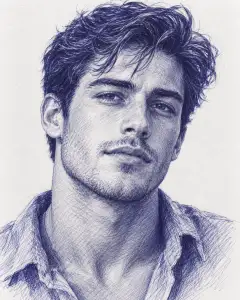
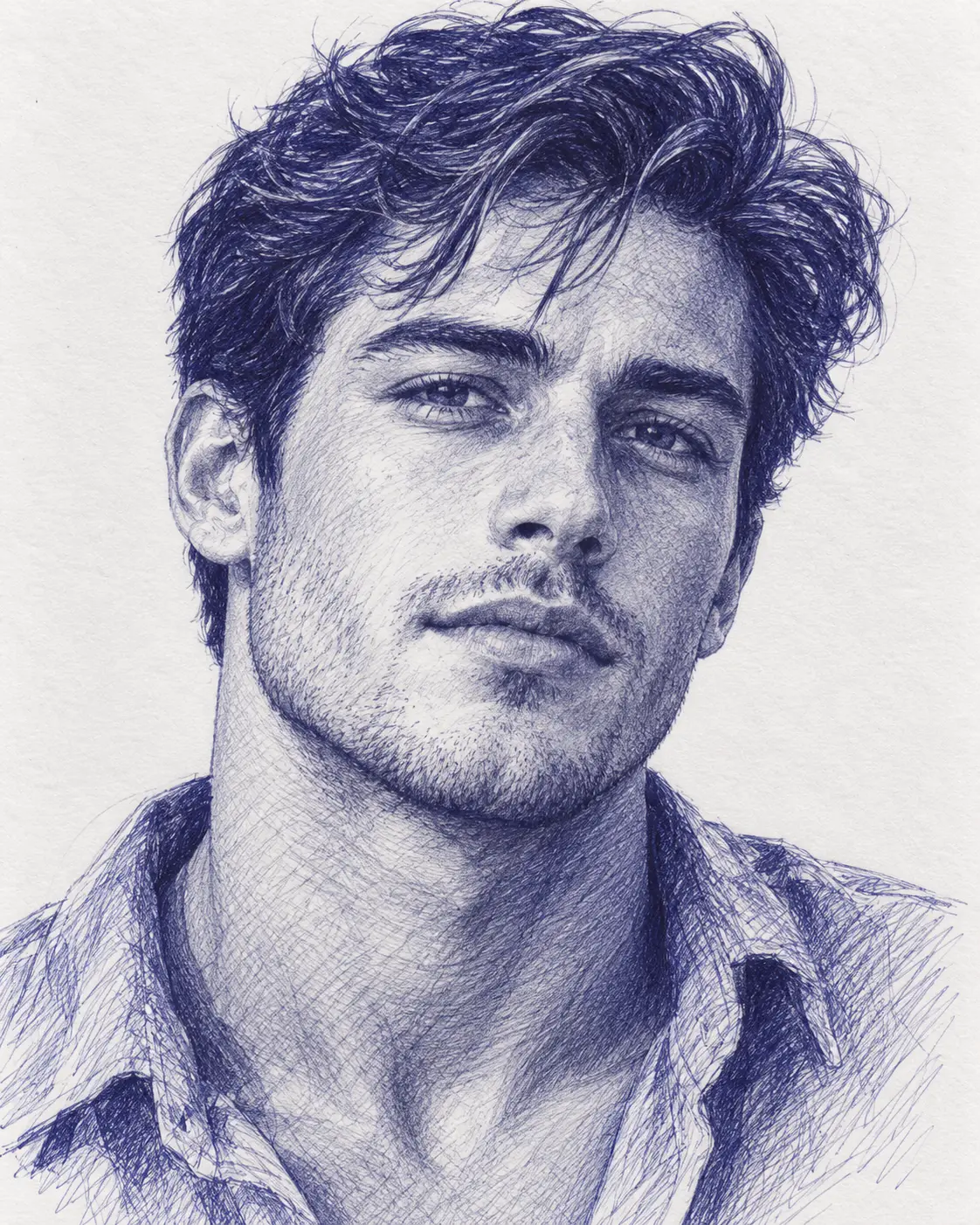
Ballpoint Pen Drawing of Handsome Male is a detailed reference-based portrait prompt designed to turn a photo of one adult man into a realistic blue-ink sketch. It prioritizes recognizable facial structure, natural proportions, hairstyle, grooming, age range, and distinctive features rather than replacing the subject with a generic model. The intended result is a close-up, head-and-shoulders portrait with a calm, confident expression and a subtle three-quarter pose.
This AI image prompt is especially useful when you want the texture of traditional drawing without losing the identity of the person in the uploaded reference. Fine contour work, layered hatching, cross-hatching, stippling, and varied ink pressure create depth across the face, hair, shirt, and neck. Deep-blue ballpoint marks sit against lightly textured warm-white paper, while negative space keeps the composition clean.
The wording can be used as a ChatGPT image prompt, Gemini image prompt, or with another reference-capable image generator. Because each model interprets likeness and handmade texture differently, the prompt provides strong visual priorities while leaving room for model-specific variation.
Best Use Cases
This prompt suits users creating personalized portrait art, profile illustrations, editorial-style character studies, or distinctive social media artwork. It can also help artists explore how a photographic reference might translate into monochrome pen techniques before starting a physical drawing.
It is particularly effective for vertical display formats because the requested 9:16 composition places the face prominently in the frame while allowing breathing room around the head and shoulders. The minimal background also makes the result suitable for digital galleries, portrait posts, phone wallpapers, or a clean presentation mockup.
Portrait enthusiasts, designers, illustrators, and gift creators can use this Gemini photo prompt when realistic likeness matters more than dramatic scenery. As an AI photo editing prompt, it is best understood as a complete artistic transformation rather than a minor retouch: the source subject remains recognizable, but the photographic appearance becomes hand-rendered blue ballpoint artwork.
How to Customize This Prompt
Start with a clear reference that shows the face, eyes, hairstyle, and jawline without heavy obstruction. Customization should preserve identity while adjusting presentation details that do not define the person.
- Change the expression from slightly serious to friendly, thoughtful, or neutral, while keeping facial proportions stable.
- Adjust the head angle only modestly. A frontal view may strengthen symmetry, while a gentle three-quarter angle adds dimensionality.
- Replace the open-collar shirt with another simple garment, but avoid intricate patterns that could compete with facial linework.
- Specify lighter or denser cross-hatching depending on whether you prefer an airy sketch or a darker, more dramatic ink portrait.
- Refine the paper as bright white, warm ivory, or lightly grained, while retaining a clean monochrome blue-ink appearance.
- Keep 9:16 for vertical artwork, or request another portrait ratio if your chosen platform has different display requirements.
For a Gemini image prompt or ChatGPT image prompt workflow, make one or two changes at a time. This makes it easier to identify which instruction improved or weakened the result.
Tips for Better Results
Reference quality has a major effect on facial resemblance. Use a sharp, well-lit photo with both eyes visible and limited perspective distortion. Avoid very small files, strong beauty filters, or harsh shadows that conceal important features.
- State clearly that there should be one adult male subject only. This reduces duplicate figures and unintended background people.
- Keep identity preservation near the beginning of the request so the model treats it as a primary requirement.
- If the first result looks too photographic, reinforce authentic pen pressure, imperfect handmade lines, visible hatching, and paper grain.
- If the face becomes too dark, request sparser marks in highlighted areas and denser strokes only in the intended shadows.
- If likeness is weak, simplify secondary details and emphasize the eyes, eyebrows, nose, lips, jawline, hairstyle, and distinctive features.
- Check the eyes, ears, shoulders, and shirt opening for anatomy problems before evaluating small texture details.
- Ask for crisp facial focus with softer outer sketch lines so the portrait feels intentional rather than uniformly overworked.
Some generators may treat “4K” mainly as a quality cue rather than a guaranteed output resolution. Use the highest available generation setting, then upscale only after confirming that the face and ink texture are correct.
What to Expect
A successful result should resemble a premium editorial portrait drawn entirely with deep-blue ballpoint pen. Expect intricate marks around the eyes, cheekbones, nose, lips, facial hair, and hair, with looser treatment across the shirt and shoulders. Soft lighting from the upper-left or front should be communicated through variations in stroke density rather than photographic color.
The paper should remain uncluttered, with subtle grain and generous negative space. The strongest images will show realistic tonal depth, natural skin texture, clear eye highlights, and small irregularities that suggest genuine handwork rather than a smooth digital filter.
Results will vary by model, reference handling, and generation settings. One system may preserve likeness well but simplify cross-hatching, while another may produce richer ink texture with slight facial changes. Iterative adjustments to identity strength, line density, lighting, and composition usually provide better control than adding many new style instructions at once.